
The 2050Today methodology for measuring greenhouse gas (GHG) emissions follows the GHG Protocol. This protocol provides organisations with standards and guidance for measuring and managing the emissions responsible for global warming. It was established in 1998 as part of a partnership between the World Resources Institute (WRI) and the World Business Council for Sustainable Development (WBCSD).
According to the GHG Protocol, emissions are categorised by scope:
Scope 1 represents direct emissions resulting from the consumption of fossil fuels.
Scope 2 represents indirect emissions from the generation of purchased electricity, steam, heating and cooling consumed by the reporting company.
Scope 3 includes all other indirect emissions that occur in a company’s value chain (i.e. purchased good or services, business travel, employee commuting).
The 2050 carbon footprint takes into account the reported emissions generated by the institution’s activities over the course of a year and is broken down into the following categories:
Energy and water
It takes into account the amount of the consumed electricity produced and purchased by the institution. The energy consumed to heat and/or cool the institution’s building area and the consumed water are included as well.
Mobility
It takes into consideration business travels and commuting (on a survey basis).
Food
The carbon footprint of food consumption includes meals provided by the organisation and individual consumption (based on a survey) during working hours.
Purchased goods
The scope of the goods purchased is limited to a list of new office equipment, new transport equipment (vehicles) and building materials.
Waste
The perimeter of the waste inventory is set to waste production from facilities and internal operations of the institution.
It should be noted that the data collected by 2050Today members for each carbon footprint is not yet fully standardised and may not be entirely complete. Data collection is gradually being harmonised and improved. Consequently, direct comparisons of tCO2 per employee between institutions – whether in general or by sector – are not yet possible or meaningful. It has to be noted that the collected data of the 2050Today members resulting in each carbon footprint are not yet fully standardized and might not be entirely complete. Data collection is being progressively harmonized and improved. Therefore, direct comparisons between tCO2 / employee among institutions – be it in general or per sector – are not yet possible nor relevant. To ensure the reliability, the accuracy and a recurrent updating of the carbon footprint assessment, 2050Today is advised by an international Carbon Footprint Scientific Committee.
GHG data is collected annually through the 2050Today Focal Points. Focal Points are representatives appointed by the members of 2050Aujourd’hui. They are responsible for coordinating the data collection process within their respective organisations and ensuring the quality of the data. The 2050Aujourd’hui team guides and supports the Focal Points throughout the data collection process.
The GHG Protocol Corporate Accounting and Reporting Standard (Corporate Standard) sets out a standard set of accounting and reporting rules for the preparation of corporate inventories. The Corporate Standard identifies and categorises emissions from all operations within an organisation. For effective and innovative GHG management, defining comprehensive operational boundaries for direct and indirect emissions helps organisations better manage the full range of GHG-related risks and opportunities that exist throughout their value chain.
The GHG Protocol classifies emissions into Scope 1, Scope 2 and Scope 3 emissions. This classification helps to distinguish between direct and indirect emission sources, improve transparency, and adapt to different types of organisations and different types of climate policies and business objectives. These three “scope categories” are defined for the purposes of GHG accounting and reporting.
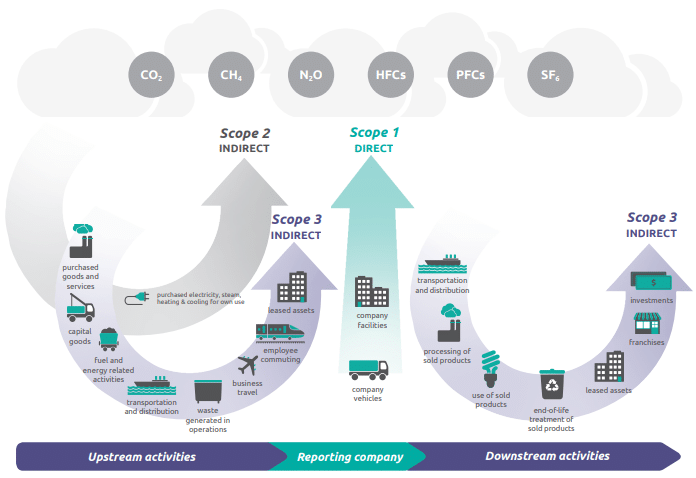
Scope 1 covers direct emissions, i.e. emissions from sources owned and controlled by the reporting institution.
Organisations report GHG emissions from sources they own or control within Scope 1. Direct GHG emissions are primarily the result of the following types of activities undertaken by the organisation:
Production of electricity, heat or steam. Stationary combustion refers to emissions from fuels burned in stationary equipment, such as the combustion of oil or gas in a local heating system.
Physical or chemical treatment, such as fumes released during on-site manufacturing and other industrial processes.
The transport of materials, products, waste and staff. Emissions resulting from the combustion of fuel used by the company’s vehicle fleet fall under the category of mobile combustion.
Fugitive emissions. Emissions of chemicals from air-conditioning and refrigeration equipment owned or controlled by institutions.
Scope 2 refers to a category of indirect emissions comprising GHG emissions resulting from the generation of electricity, steam, heat or cooling that is purchased or acquired and consumed by the reporting organisation.
Scope 2 includes emissions from energy purchased or procured and consumed by the reporting organisation:
Electricity This type of energy is used by almost every organisation. It is used to power machinery, lighting, electric vehicle charging, and certain types of heating and cooling systems.
Steam Produced by boiling water, steam is a valuable source of energy for industrial processes. It is used for mechanical work, heating or directly as a process fluid.
Heat Most public, commercial or industrial buildings require heat to regulate the indoor climate and heat water. Many industrial processes also require heat for specific equipment. This heat can be generated from electricity or through a non-electrical process such as solar heat or thermal combustion processes (such as a boiler or a thermal power station) outside the institution’s operational control.
Cooling Like heating, cooling can be generated using electricity or by circulating cooled air or water.
2050Today refers to the GHG Protocol’s value chain (Scope 3) accounting and reporting standard – which is a supplement to the corporate standard – to define the GHG emissions inventory that includes indirect emissions resulting from value chain activities. Scope 3 emissions form part of these indirect emissions.
Emissions within Scope 3 include emissions from the upstream and downstream value chain:
Upstream emissions
1. Goods and services purchased
2. Capital goods
3. Fuel and energy-related activities not covered by Scope 1 or Scope 2
4. Upstream transport and distribution
5. Waste generated by operations
6. Business travel
7. Employees’ commutes
8. Assets leased upstream.
Downstream emissions
9. Transport and downstream distribution
10. Processing of goods sold
11. Use of the products sold
12. End-of-life management of products sold
13. Assets leased downstream
14. Franchises
15. Investments
The 2050Today inventory includes GHG emissions under the operational control of its members based in International Geneva. In other words, only operations carried out or financed by institutions based in International Geneva are covered. The 2050Today inventory includes all GHG emissions from Scopes 1, 2 and 3. The reported Scope 3 GHG emissions are selected based on their relevance to the institutions’ activities and are therefore not exhaustive. Scopes 1, 2 and 3 are mutually exclusive for the reporting institution, so there is no double counting of emissions across the scopes.
Given the nature of 2050Today’s member organisations, we have selected the most relevant indicators from the categories listed below to help them understand the impact of their emissions across the entire value chain, so that efforts can be focused where 2050Today members can have the greatest impact.
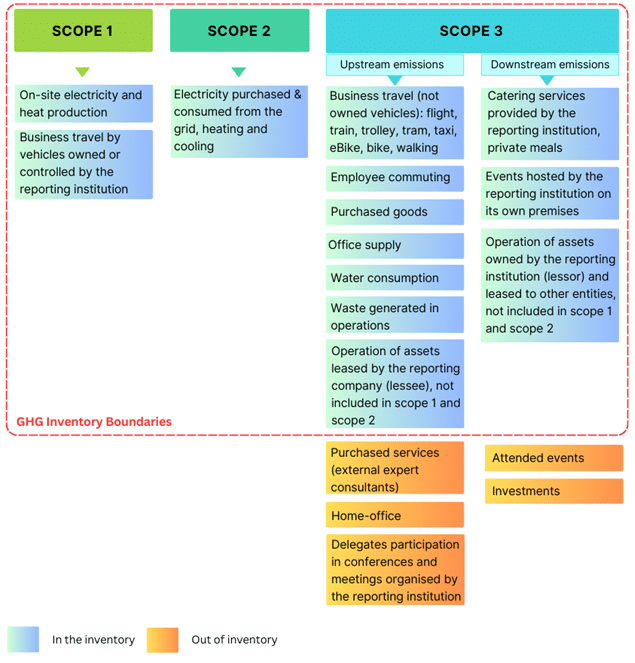
The energy and water category takes into account the amount of electricity consumed, generated and purchased by the institution. Energy used to heat and/or cool the institution’s buildings and water consumption are also included.
This section includes indicators relating to the consumption of food and drink provided by the institution. It covers food and drink served in the institution’s cafeteria and/or at internal events.
This sector covers emissions from new office equipment, new transport equipment (vehicles) and building materials.
The scope of the 2050Today waste inventory is defined as the waste generated by the institution’s internal facilities and operations during the year in question.
Each category comprises several indicators used to define a specific inventory for measuring the carbon footprint. Each indicator is multiplied by its associated emission factor to estimate the corresponding GHG emissions. The factors are based on a full life-cycle analysis of goods and services and take into account the associated emissions. For purchased goods, the factors take production into account. Emissions related to use and end-of-life are measured separately and at a later stage.
Emission factors are regularly updated and categorised by year of use. Due to these regular updates, differences may arise when comparing similar reported values. In the event of a significant update to the emission factors, a note will indicate the change in the footprint report for the year in question.
To ensure the reliability, accuracy and regular updating of carbon footprint assessments, 2050Today is advised by an international scientific committee on carbon footprints, comprising experts in GHG assessment who represent specialist and recognised institutions.
The main role of the Scientific Committee is to review, on an annual basis, the methodology used by 2050Today to measure, calculate and account for greenhouse gases, and to confirm that it complies with standard carbon accounting practice and adheres to the principles of the GHG Protocol.
The perimeter of the 2050Today waste inventory is set to waste production from facilities and internal operations of the institution during the reported year. Only waste treatment in facilities owned or operated by third parties is included in scope 3. The method requires the collection of data on waste quantities by waste type (e.g., Paper, PET, Metal, Biodegradable) and by type of treatment and disposal (Recycled/re-used and not recycled). The waste inventory is part of Scope 3 emissions, Category 5 (Waste generated in operations). Treatment of waste generated in operations is categorized as an upstream scope 3 category because waste management services are purchased by the reporting institution.
This sector includes indicators on the consumption of food and drink items offered by the institution. It includes food and drinks provided at the institution’s cafeteria and/or during in-house events. These indicators are also part of Scope 3 emissions, Category 1 with a “cradle to gate” boundary. Individual food consumption by employees during working hours is also measured.
In this sector, 2050today also use the Average-data method.
The parameter of this sector is set to a list of new office equipment, new mobility equipment (vehicles) and construction materials. Listed indicators are part of Scope 3 GHG emissions, category 1 (Purchased goods and services) with a “cradle to gate” or “upstream” boundary (extraction, production and transportation of goods purchased or acquired by the reporting institution during the year).
To calculate emissions from purchased goods and services, 2050today use the Average-data method, which means estimating emissions for goods and services by collecting data on the mass (e.g., kilograms or pounds), or other relevant units of goods or services purchased and multiplying by the relevant secondary (e.g., industry average) emission factors (e.g., average emissions per unit of good or service).
The Mobility sector is separated into two categories based on the ownership of the vehicles. Emissions from transportation in vehicles owned or leased by the institution are accounted either in Scope 1 (for fuel use) or Scope 2 (for electricity use), while emissions from transportation in vehicles not controlled by the institution (e.g., employees business travel & employee commuting) are part of Scope 3 GHG emissions The institution should be particularly careful if it owns electric vehicles as to avoid double counting of GHG emissions (electricity consumption of electric vehicles could be already included in building electricity consumption).
Data on employees commuting trips is collected through an online flash questionnaire that is sent directly to institutions’ employees. The data in this section is part of Scope 3 GHG emissions, Category 7 (Employee Commuting). This anonymous data is processed directly by 2050Today and will be reported in the calculation of the institutions’ global carbon footprint.
A summary of the vehicle fleet is demanded, and the method requires the collection of data on distances travelled (km) or on fuel usage (kWh of electricity or liters of petrol, diesel, natural gas or biofuel) per vehicle type.
Employee business travels and employee commuting trips data are collected for reporting. The data in this section is part of Scope 3 GHG emissions, Category 6 (Business Travel). Data on terrestrial mobility, similarly to institution owned vehicles data, is collected for distances travelled (km) or for fuel usage (kWh of electricity or liters of petrol, diesel, natural gas or biofuel) per vehicle type. For aerial mobility, the method requires the institution to share information on distances travelled (cumulated km) and/or associated GHG emissions (tCO2-eq.). The share of compensated flights can also be inserted into the form.
For flights, 2050Today uses the Mobitool version 3.0 factors to estimate GHG emissions. The calculation is based on the Atmosfair method which includes the ICAO references and method. In addition to the pure CO2 emissions there are also non-CO2 emissions for flights, which are also recorded, calculated and reported with their climate impact in the Atmosfair method. It uses state of the art of climate science according to IPCC and peer reviewed literature.
The number of nights employees stayed at a hotel in the context of a business trip are included in the Mobility perimeter. This portion of emissions belong to Scope 3.
The perimeter of 2050Today inventory is set to the purchase of grid electricity (in kWh) directly by the institution or through the entity managing the facility. If electricity is produced (through solar photovoltaic panels for instance) and consumed on-site, it is also considered in the inventory. All emissions from grid electricity purchased & consumed by the institution belong to Scope 2. Among the on-site produced & consumed electricity, emissions from combined heat & power installation, oil and natural gas belong to Scope 1.
According to the GHG Protocol, if an institution can be provided with product-specific data in the form of guarantees of origin, certificates, contracts, or other contractual instruments, it will report two scope 2 totals for the overall GHG inventory: one market-based, and one location-based. To be as accurate as possible the physical reality of GHG emissions, 2050Today reports location-based emissions.
The location-based method is calculated using Horocarbon UNIGE assessment tool to measure the grid average emission factor for Geneva.
We have further categorized the electricity purchased from the grid based on its source. For the electricity purchased from SIG, it includes different types of products such as Electricité Vitale Bleu or Electricité Vitale Soleil. There may also be a portion of electricity sourced from coal, oil, solar, or wind power. In this inventory, institutions can fill in the corresponding table with data based on the generation source of the electricity they have purchased.
2050Today’s carbon footprint methodology considers only the location-based method, or in other words grid electricity emissions. Product-specific data can be provided through the data entry form for information purposes and referenced accordingly but not considered in GHG calculations.
For this category, the amount of the energy source consumed to heat and/or cool the institution’s building area are included (e.g., liters of heating oil, m3 of natural gas, kWh of electricity). If the institution is benefiting from GeniLac, it can indicate the total quantity of water that was used by the system during the year.
If one institution purchases heating or cooling services from district heating or SIG product, this portion of emissions would belong to Scope 2. If one institution generates heating or cooling on site from energy sources like natural gas or oil, this portion of emissions would belong to Scope 1. We also categorized the heating & cooling based on its source, so that institutions can fill in the corresponding table with data based on the generation source.
The cooling perimeter also includes the use of refrigerants for air conditioning. If the refrigerants which belong to GHG are leaked or released into the atmosphere directly, this portion of emission belongs to Scope 1. If we consider the value chain of production of refrigerants, it belongs to Scope 3.
The perimeter of the 2050Today inventory is set to water consumption by the institution. The method requires the collection of data on water in m3 or in liters. Emissions from water consumption belong to Scope 3.